Stop juggling multiple operators. KubeBlocks gives your team a single, production-grade control plane to run and manage any database—MySQL, PostgreSQL, Kafka, MongoDB, and 30+ more—with one unified API.
35+
DB Engines
20K+
Managed Instances
50+
Enterprise Customers
100+
Contributors
3.2k+
GitHub Stars
Every operator ships its own CRDs, its own backup logic, its own upgrade path. Whether you're using kubectl, Helm or ArgoCD—you're learning a new dialect for every engine you add.
Without KubeBlocks
Operator Sprawl
N databases = N CRD schemas = N GitOps configs to maintain
MySQL Operator
PostgreSQL Operator
Redis Operator
MongoDB Operator
Kafka Operator
5
Operators to install
15
Concerns to manage
∞
Complexity as you scale
VS
VS
With KubeBlocks
One Unified API
One CRD schema. One GitOps workflow. One team that owns everything.
KubeBlocks
Unified API · Single Control Plane
Backup & Recovery
Instant Backup
Point-in-Time Recovery
Delete Protection
Observability
Metrics & Logs
Slow SQL Analysis
Alert Rules
Lifecycle
Rolling Upgrade
Auto Failover
HA Architecture
1
Operator to install
3
Concerns to manage
0
Extra complexity when scaling
From relational to NoSQL, from streaming to vector—KubeBlocks covers the modern data stack.
Relational
Analytics
ClickHouse
StarRocks
AI / Vector / Graph
Time Series / Observability
InfluxDB
TDEngine
Loki
VictoriaMetrics
GreptimeDB
Object Storage
Trusted by Engineering Teams at Scale
 BONC Cloud
 China Mobile Cloud
 China Telecom Cloud
 Tencent
 Xiaomi
 Ping An
 VIP.com
 Kwai
Kwai Tiger Brokers
 CITIC Securities
 SealOS
 FastGPT
 KubeSphere
 Momenta
 360
360 Tilaa
Tilaa Olares
 Changan Automobile
 State GridBONC CloudChina Mobile CloudChina Telecom CloudTencentXiaomiPing AnVIP.comKwaiTiger BrokersCITIC SecuritiesSealOSFastGPTKubeSphereMomenta360TilaaOlaresChangan AutomobileState Grid
Real engineering teams. Real production workloads. Real numbers.
1 Engineer. 6,000+ Databases. No DBA Team.
By adopting KubeBlocks' declarative management and automated workflows, a single Kubernetes engineer — without a DBA background — now reliably manages over 6,000 database instances across four regions.
1,000+ Clusters, One Unified Operations Experience
VIP.com adopted KubeBlocks to unify operations for MySQL, ElasticSearch, and Kafka. With 1,000+ clusters and 3,000+ nodes, they now enjoy a consistent, automated operational experience across entirely different database engines.
2× Resource Utilization at 10,000-Pod Scale
Kuaishou built a custom federated architecture with KubeBlocks that deploys Redis across multiple K8s clusters — ultimately doubling resource utilization while hiding all complexity from end-users.
100% Infrastructure as Code for Financial Data
Tiger Brokers integrated KubeBlocks into their GitOps workflows. Using IaC, they seamlessly provision and manage MySQL, Redis, RabbitMQ, Kafka, and ZooKeeper — ensuring strict version control and rapid deployment.
Built a Full DBaaS Platform in Weeks, Not Quarters
China Mobile Cloud chose KubeBlocks to power He3DB — their AWS Aurora-comparable flagship database. By developing KubeBlocks Addons instead of building Operators from scratch, they cut platform development time from months to weeks.
Whether you're managing databases as code, building an internal developer platform, or shipping a database service—KubeBlocks fits your workflow.
Declare All Your Databases as Code
Manage every database engine through the same Kubernetes-native CRDs you already use for your apps. Write once in YAML, apply via ArgoCD or Flux, and let KubeBlocks reconcile the desired state—no imperative scripts, no snowflake configs.
“KubeBlocks is a very unique project that focuses on running multiple databases in Kubernetes — the best solution for a wide range of databases. It can be a great fit for Kubernetes users who want to migrate their databases to run on Kubernetes without wanting to lose control.”

Viktor Farcic
Developer Evangelist @Upbound · Google Developer Expert · CDF Ambassador
“KubeBlocks has a very short release cycle and is very actively developed. The Addon concept is what makes KubeBlocks have the most contributors — KubeBlocks also provides support for AI, such as MilvusDB, which is part of a modern large model technology stack.”

Sergy Pronin
Product Owner @Percona · Cloud-Native Database Solutions
Not just for demos. KubeBlocks is built for teams who run databases at scale—where reliability, flexibility, and operational simplicity are non-negotiable.
One API, Any Database, Zero Re-Learning
Stop learning a new operator for every database you add. KubeBlocks provides a single, unified API to provision, scale, and manage any database—drastically reducing operational complexity and training costs.
Onboard Any Database Engine — No Operator SDK Required
Bring any database to Kubernetes without writing complex Golang operators. KubeBlocks' low-code Addon architecture lets you define engine behavior in configuration files, turning your DBA knowledge into automated, declarative workflows.
Upgrade Databases Without Waking Up at 3 AM
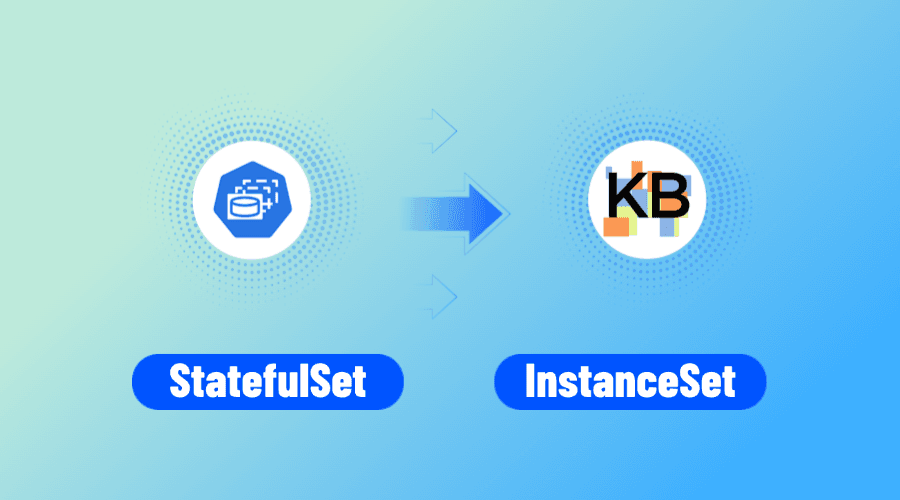
KubeBlocks' innovative InstanceSet enables role-aware management, in-place pod updates, and the ability to take individual instances offline for proactive maintenance—all without disrupting your production traffic.
Deploy Exactly What Your Workload Needs
Whether you need a lightweight single-node instance for dev/test, a robust primary-replica setup, or a complex sharded cluster with custom proxies—KubeBlocks adapts to your specific requirements without extra configuration overhead.
Run Anywhere. Lock In to Nothing.
KubeBlocks is fully Kubernetes-native, ensuring seamless deployment across AWS EKS, Google GKE, Azure AKS, or on-premises environments including OpenShift and OpenStack Magnum—eliminating vendor lock-in completely.
Production-Grade HA with Minimal Overhead
Ensure your mission-critical data is always accessible. KubeBlocks features a decentralized, lightweight high-availability architecture with built-in auto-failover, perfectly suited for managing massive MySQL and Redis clusters.
Helm charts deploy databases — they don't operate them. Backup, failover, scaling, and upgrades require manual scripts or custom tooling. KubeBlocks provides these as first-class declarative APIs, out of the box.
Helm / Bitnami
Install database
Backup & restore
Failover automation
Scaling operations
Version upgrades
KubeBlocks
Install database
Backup & restore
Failover automation
Scaling operations
Version upgrades
From 1 Cluster to 10,000 — the Same Command Works
Use kbcli for an intuitive developer experience, or integrate seamlessly with your GitOps pipelines using declarative YAMLs. Your workflow scales with your infrastructure.
~ zsh
$
kbcli cluster list -A
NAME NAMESPACE CLUSTER-DEFINITION STATUS
mysql-8-4-4 demo mysql Running
pg-cluster demo postgresql Running
clickhouse-clust demo clickhouse Running
$
kbcli cluster describe mysql-8-4-4 -n demo
INSTANCE ROLE STATUS AZ
mysql-8-4-4-mysql-0 secondary Running ap-southeast-1a
mysql-8-4-4-mysql-1 primary Running ap-southeast-1a
Never Lose a Byte of Data
Execute instant backups, schedule automated policies, and perform precise Point-in-Time Recovery (PITR) to restore your database to any specific second. Enterprise-grade data protection, out of the box.
backup-schedule.yaml
Know What's Happening Before Your Users Do
KubeBlocks provides out-of-the-box integration with Prometheus and Grafana, offering detailed metrics, slow SQL analysis, and customizable alert rules—so you catch problems before they become incidents.
grafana · KubeBlocks Elasticsearch Dashboard

Put Your Database Operations on Autopilot
From rolling upgrades and vertical scaling to automatic failure recovery and data-at-rest encryption—KubeBlocks handles the heavy lifting so your team can focus on building, not babysitting.
Requires a running Kubernetes cluster and Helm 3.
⚡ No Kubernetes cluster? Try the hosted playground — no installation requiredAdd Helm repo
helm repo add kubeblocks https://apecloud.github.io/helm-charts
helm repo update
Install KubeBlocks
Create a MySQL cluster
Verify
Open source and production-ready. Enterprise customers get dedicated onboarding and migration support.